 |
| priceonomics.com |
Every athlete hopes to make money that can support their families, but franchises have to limit the amount of money each player receives by different factors, such as ability. In an article, “Are Salary Caps for Professional Athletes Fair?” written by Jim Pagels, a writer and researcher on markets, sports, economics, and stats; he will help me answer the following question.
In this post, I will be answering the question Why do different sports have different caps? And are their success rates higher? In today’s society, it is beneficial to have salary caps, in all sports to give an equal opportunity to players and franchises. I argue that salary caps will help lead to success, because it gives opportunity to teams that do not have much.
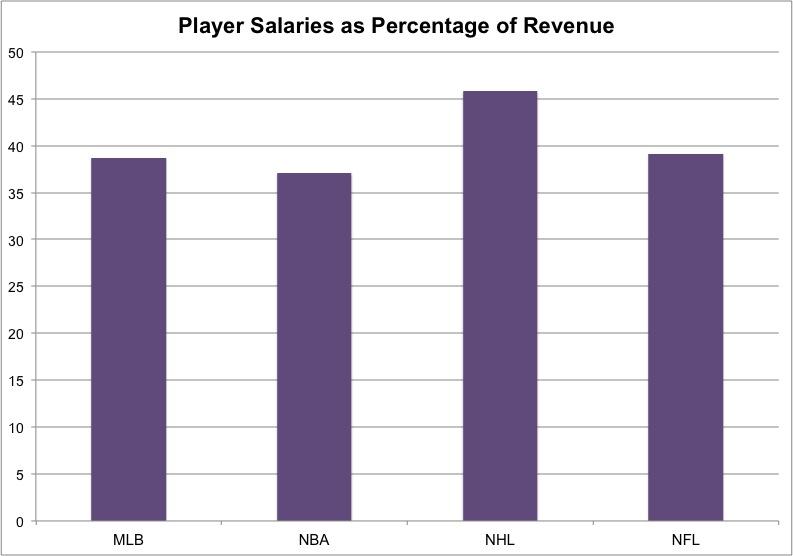
- Each sport will have a different percentage of what the players can receive verse the owners. In the article Pagels states that “most leagues split mandatory sport-specific revenue roughly 50-50 between owners and players.” But recently many organizations such as the NHL, NBA, and NFL “players have agreed to accept a smaller slice of the pie.[...] labor negotiations, players went from receiving 57% of basketball- and hockey-related income to 50% while NFL players went from a 50/50 split to 47%. When factoring in total league revenues, players’ shares are slightly smaller, but roughly equal across sports” This states that every sport has different types of caps, but by very little percents.
- The continued path of salary caps, we see that players just want to play, but they also want a fair amount of money but it is hard to with stubborn owners. In the article it states that “players realized that holding out for a higher share of revenues was not worth missing part of the season. After all, any additional revenue players could earn in the future would be negated by lost wages in the present. This provided owners with a huge bargaining advantage. While the players have limited career windows to earn money in the league, the owners have their entire lives” This shows that players are worried about the present, and less about their future, even thought that the sooner they play the more time and money they will receive.
- Prior to Salary caps, when sports were just sports, and money was not as big of a deal as it is now, they had the “ ‘reserve clause,’ which prohibited players from negotiating with other teams, even after the conclusion of a contract.” This is the way every sport had an equal playing ground, and every team within a sport had equal playing ground, because it was a simple idea of how to give a player money without the player saying ‘no, I deserve more’.
Future Research Question: How do endorsements factor into athlete's life?

No comments:
Post a Comment